Why Data Sovereignty Matters for AI Workloads in Financial Services

If you’re accountable for AI infrastructure in a regulated financial environment, data sovereignty isn’t an abstract compliance concept—it’s an operational reality that shapes where you can deploy workloads, how you architect systems, and what you can demonstrate to examiners. As the EU AI Act enforcement ramps up through 2025, the window to address sovereignty gaps before they become audit findings is narrowing.

The good news: institutions don’t have to choose between the cloud experience their platform teams expect and the sovereign control regulators require. This article explains what data sovereignty means in practice for infrastructure leaders, why it becomes complex as AI scales, and how to build architecture that delivers both agility and compliance.

What Is Data Sovereignty for AI Workloads in Financial Services?

Data sovereignty for AI workloads in financial services means ensuring that sensitive customer data, model training datasets, and inference outputs remain under the institution’s legal and operational control—subject only to the laws of jurisdictions where the institution chooses to operate. This principle becomes critical as AI systems process increasing volumes of regulated data.

In practice, sovereignty involves three dimensions that infrastructure leaders must address:

  • Geographic residency: knowing which jurisdiction houses your data at rest and in transit, and being able to demonstrate this to examiners
  • Access governance: controlling who can access data, including how you respond to foreign government requests
  • Operational control: maintaining the ability to move, delete, or audit data without third-party dependency—your exit path if provider relationships change

For GPU-intensive workloads, sovereignty becomes particularly complex. Training runs may span multiple availability zones, inference services cache data across locations, and model weights themselves constitute sensitive IP requiring protection. Each of these creates documentation and audit requirements you’ll need to satisfy.

How Do Hyperscaler Architectures Create Sovereignty Exposure?

Sovereignty exposure emerges from the fundamental architecture of global cloud infrastructure—not malicious intent. Understanding these structural factors helps you assess your current posture and explain risk to stakeholders:

  • Jurisdictional complexity: Data may traverse multiple jurisdictions during processing. The U.S. CLOUD Act can compel U.S.-headquartered providers to produce data stored abroad, creating tension with frameworks like GDPR. The European Data Protection Board has noted these conflicts require careful assessment. For infrastructure leaders, this means data in Frankfurt on AWS may still be subject to U.S. jurisdiction—a concern examiners increasingly scrutinize.
  • Shared infrastructure risks: Hyperscalers operate multi-tenant infrastructure with logical rather than physical isolation. Regulators increasingly ask institutions to demonstrate they can audit tenant boundaries—challenging for SOC 2, ISO 27001, or SR 11-7 compliance. Can you produce the documentation an examiner would request?
  • Limited transparency: Institutions have restricted visibility into how data is processed, cached, or replicated. Examiners typically request data flow diagrams with jurisdiction markers, third-party risk assessments, and access control inventories—documentation that’s difficult to produce without infrastructure-level visibility.

The OCC emphasizes that institutions remain responsible for compliance regardless of where workloads run. Outsourcing infrastructure doesn’t outsource accountability—you need to be able to demonstrate control to satisfy examiner requests.

What Sovereignty Challenges Emerge as AI Scales?

Sovereignty challenges surface gradually as AI adoption grows, often catching infrastructure teams off guard during audits:

  • Pilot-to-production drift: Sandboxed experiments become production systems without infrastructure review, inheriting sovereignty gaps from development environments
  • Shadow AI sprawl: Business units spin up initiatives without centralized oversight, creating sovereignty exposure you may not discover until an audit
  • Vendor lock-in: Managed services and proprietary tooling accumulate switching costs, limiting your exit options if sovereignty requirements change
  • Compliance lag: Regulatory requirements (DORA, EU AI Act) evolve faster than infrastructure decisions, creating gaps between architecture and obligations

A Framework for Workload Classification

Not all workloads carry the same sovereignty requirements. This framework provides a starting point for infrastructure decisions—actual choices will involve additional nuance based on your regulatory footprint:

Workload Type
Data Sensitivity
Regulatory Risk
Infrastructure Recommendation
Research & experimentation
Low (synthetic)
Low
Public cloud acceptable
Production training
Medium-High
Medium-High
Dedicated sovereign infrastructure
Customer-facing inference
High (real-time PII)
High
Single-tenant, geography-guaranteed
Agentic AI systems
High (autonomous)
High (EU AI Act)
Single-tenant with audit trail

Figure 1: Workload Classification Framework

Does Sovereign Infrastructure Mean Sacrificing Operational Agility?

No—modern sovereign infrastructure preserves the cloud experience platform teams expect while adding the controls compliance requires. Sovereignty doesn’t mean returning to on-premises complexity. The key is hybrid architecture that segments workloads based on sensitivity while maintaining operational velocity:

  • Data classification gateway: Routes data based on sensitivity; PII flows to sovereign infrastructure while anonymized data leverages cloud resources—with clear audit trails for each path
  • Secure interconnect: Private links via Direct Connect or ExpressRoute, which can typically achieve sub-10ms latency depending on configuration—performance your teams won’t notice
  • Unified operating model: Run bare metal, managed LLM services, and agentic systems on a single platform with consistent tooling—maintaining developer experience across sovereignty boundaries
  • Standard ML toolchains: Full compatibility with CUDA, PyTorch, Kubernetes, and MLOps platforms—no proprietary modifications required, preserving portability

What Does This Look Like in Practice?

Consider a representative example based on Arc Compute client experience: a $45B AUM asset manager that transitioned customer-facing inference from a hyperscaler to sovereign infrastructure.

Before: Examiner requests for data flow documentation took weeks to assemble. The team couldn’t clearly demonstrate which jurisdictions processed customer data, and concentration risk concerns flagged in regulatory reviews.

After: Geographic certainty with single-tenant deployment in documented jurisdictions. Examiner requests now satisfied within days. Deployment cycles reduced from four weeks to five days, enabling 3.2x more model updates annually—sovereignty controls actually improved operational velocity by simplifying compliance documentation.

Go Deeper: In our upcoming webinar, we’ll walk through the hybrid architecture pattern in detail—including how to run bare metal, LLM services, and agents on a single operating model while maintaining sovereignty controls. Register for the live session.

Questions to Ask When Evaluating Providers

When assessing sovereign infrastructure options, these questions help you evaluate whether a provider can support your compliance obligations:

  • Where are data centers physically located, and under which jurisdiction’s laws does the provider operate? Can they demonstrate this in documentation acceptable to your examiners?
  • How does the provider handle government data requests, particularly under the CLOUD Act? What is their notification policy, and what legal mechanisms protect your data?
  • What isolation guarantees exist—logical or physical? Can you audit tenant boundaries to satisfy SOC 2 or ISO 27001 requirements?
  • What certifications are maintained, and what does the exit/portability process look like? What’s your realistic path to migrate if sovereignty requirements change?
  • Does the provider support DORA concentration risk requirements (Articles 28-29)? Can they provide the third-party risk documentation regulators expect?

Key Takeaways

  • Data sovereignty means maintaining legal and operational control over customer data, training datasets, and inference outputs across geographic, access, and operational dimensions—and being able to demonstrate this control to examiners.
  • Hyperscaler architectures create sovereignty exposure through jurisdictional complexity, shared infrastructure, and limited transparency—structural factors that require architectural solutions, not just policy changes.
  • Sovereign infrastructure can match cloud agility through hybrid architectures with standard toolchain compatibility—sovereignty and developer experience are not mutually exclusive.
  • Workload classification enables right-sized sovereignty controls based on data sensitivity and regulatory requirements, avoiding over-engineering while ensuring compliance.

Sources

  • European Data Protection Board. “Recommendations 01/2020 on measures that supplement transfer tools.” edpb.europa.eu
  • Office of the Comptroller of the Currency. “Third-Party Relationships: Interagency Guidance on Risk Management.” OCC Bulletin 2023-17, occ.gov
  • European Parliament. “EU AI Act: first regulation on artificial intelligence.” europarl.europa.eu
  • Federal Reserve Board. “SR 11-7: Guidance on Model Risk Management.” federalreserve.gov
  • U.S. Congress. “H.R.4943 – Clarifying Lawful Overseas Use of Data Act (CLOUD Act).” Public Law 115-141 (2018), congress.gov
  • Digital Operational Resilience Act (DORA), Regulation (EU) 2022/2554, Articles 28-29.

The Hidden Costs of Hyperscaler GPUs in Financial Services

If you’re accountable for AI infrastructure costs and uptime in a regulated financial environment, you’ve likely experienced this pattern: hyperscaler GPU stacks that seemed cost-effective during pilots become budget planning nightmares at scale. Unpredictable spend variance, surprise egress fees, and capacity constraints that force premium pricing create a gap between forecast and actual costs that’s difficult to defend in board presentations.

In our work with infrastructure leaders at financial services organizations, we’ve found a consistent pattern: most underestimate Year 2 infrastructure costs by 40% or more. This estimate is based on our direct client engagements and may vary by organization.

This article explains why GPU costs become unpredictable, and provides a practical framework for building infrastructure economics you can actually forecast—without sacrificing the cloud-like experience your platform teams expect.

Why Do Hyperscaler GPU Costs Become Unpredictable?

Hyperscaler GPU costs become unpredictable because of utilization inefficiency (35-45% idle time), burst capacity premiums (40-70% over reserved pricing), hidden egress fees ($15K-$30K/month for large workloads), and regional pricing constraints that limit cost optimization options. These ranges represent typical patterns observed across our client engagements.

Hyperscaler pricing models were designed for general compute workloads with predictable utilization. GPU-intensive AI workloads violate these assumptions in ways that directly impact your ability to forecast spend:

Cost Driver
Impact on Forecast Accuracy
Utilization Inefficiency
GPUs provisioned for peak demand sit idle 35–45% of the time during debugging, meetings, and off-peak hours, capacity you’re paying for but not using.
Burst Capacity Premium
Unexpected spikes like retraining cycles or regulatory deadlines force on-demand rates at a 40–70% premium over reserved pricing, unpredictable by definition.
Data Egress Fees
For workloads processing 50–100TB monthly, model artifacts and training data transfers add $15K–$30K per month, often invisible in initial projections and difficult to attribute.
Regional Constraints
Data sovereignty requirements limit region choices; compliant regions often carry 15–25% price premiums that constrain optimization.

Research from CloudZero’s 2025 State of AI Costs report confirms this challenge: average monthly AI budgets are rising 36% in 2025, yet most organizations still struggle to accurately attribute costs to specific initiatives. For infrastructure leaders presenting to the CFO, this attribution gap makes ROI conversations particularly difficult.

What This Looks Like in Practice

A recent client engagement illustrates the pattern. A European asset manager began running fraud detection and portfolio optimization models on a major hyperscaler. Initial monthly costs of €38,000 seemed reasonable during the pilot phase.

Within 18 months, as the team expanded to real-time market analysis and customer behavior modeling, monthly bills grew to €142,000, with ±35% month-to-month variance that made budgeting nearly impossible. The infrastructure team couldn’t produce reliable spend forecasts, creating friction with finance during quarterly planning.

After implementing utilization monitoring, they discovered:

  • 38% of GPU capacity sat idle during off-peak hours
  • Data egress fees added €22,000/month, invisible in original projections
  • Regulatory reviews flagged single-provider concentration risk, constraining region choices and adding compliance overhead

By moving predictable batch training to a bare metal cloud provider with fixed monthly pricing, while keeping variable inference on the hyperscaler—they reduced monthly spend to €89,000 with variance under ±8%. Critically, model training throughput improved by 15% due to dedicated GPU allocation, delivering better performance per dollar alongside cost predictability.

We’ll walk through this type of TCO analysis in detail during our February 26, 2026 webinar.

Infrastructure Decision Framework

Before exploring infrastructure diversification, exhaust optimization within your current environment, reserved instances, spot capacity for fault-tolerant workloads, and utilization monitoring are table stakes. When those approaches hit limits, use these questions to evaluate whether diversification merits investment:

  1. Is average GPU utilization above 60%? If yes, dedicated infrastructure economics improve significantly, you’re paying for capacity you’re actually using.
  2. Are more than 40% of workloads predictable batch jobs? Predictable workloads favor committed or dedicated capacity where you can forecast costs within single-digit variance.
  3. Do cloud costs exceed 60-70% of equivalent dedicated TCO? This is the threshold where repatriation merits evaluation (per Deloitte research). Below this, optimization likely delivers better ROI than migration.
  4. Are regulatory requirements constraining your cost optimization options? Data sovereignty and concentration risk rules (such as DORA Articles 28-29) may limit region choices, forcing you into higher-priced compliant regions or requiring multi-provider architectures regardless of cost.
  5. Can you accurately attribute AI costs to specific initiatives today? If you can’t demonstrate ROI per initiative to the CFO, governance improvements should precede infrastructure changes. You need visibility before you can optimize.

Building Predictable ROI for AI Infrastructure

Infrastructure leaders can build predictable ROI by matching workload characteristics to appropriate infrastructure: dedicated capacity for predictable training, cloud elasticity for variable inference, and strict cost attribution across all initiatives—while preserving the cloud-like experience platform teams expect.

A note on terminology:

“Dedicated infrastructure” refers to bare metal cloud providers, colocation facilities, or managed private cloud environments where you control capacity allocation—as distinct from shared hyperscaler instances with consumption-based pricing.

Preserving the cloud experience:

A common concern: will moving to dedicated infrastructure sacrifice the agility platform teams expect? Modern bare metal cloud providers now offer API-driven provisioning, Kubernetes-native environments, and self-service portals that match hyperscaler developer experience. The goal isn’t to abandon cloud benefits—it’s to achieve predictable economics and better performance per dollar while maintaining operational velocity.

Workload placement strategy:

  • Predictable, high-utilization training workloads warrant dedicated capacity with fixed monthly pricing. These deliver the best performance per dollar and enable reliable forecasting.
  • Variable inference loads benefit from cloud elasticity with reserved instance coverage to cap costs.
  • Experimentation workloads run best on cloud with cost guardrails and auto-shutdown policies to prevent runaway spend.

Plan for transition costs:

Data migration, application refactoring, and team training add 12-24 months to any infrastructure transition. Start with new workloads on diversified infrastructure while gradually migrating existing applications. Factor these costs into your ROI model.

Establish cost attribution:

Without clear visibility into which initiatives drive which costs, you cannot demonstrate ROI to leadership or defend your budget. Building cost awareness into platform operations consistently outperforms treating AI infrastructure as an unlimited commodity.

Moving Forward

AI infrastructure doesn’t have to be a source of budget anxiety. With clear visibility into cost drivers, workload-appropriate infrastructure choices, and governance frameworks enabling per-initiative ROI tracking, infrastructure leaders can transform AI from an unpredictable cost center into a strategic asset with defensible economics, while preserving the operational velocity their teams depend on.

The question isn’t whether to scale AI, it’s whether you can do so with economics you can forecast and defend.

Go Deeper: Live Webinar on February 26, 2026

This article introduces the framework. The webinar goes deeper into implementation.

Join Arc Compute and WEKA on Thursday, February 26, 2026 at 2:00 PM ET for a live session covering:

  • How to achieve predictable economics and reduced spend variance without abandoning cloud agility
  • Performance per dollar benchmarks for different workload types
  • How to run bare metal, LLM services, and agents on a single operating model
  • Real-world TCO patterns and tradeoffs, plus live Q&A

This is not a product demo. The focus is on architecture, operating models, and decision criteria that hold up in regulated financial environments.

Register now: Predictable AI Infrastructure for Finance 

References

From Overnight Risk to Intraday Decisions: How AI and GPUs Are Reshaping Financial Risk Management

Financial markets are moving faster than the risk infrastructure many institutions still rely on, making delayed risk insight increasingly costly. To keep pace, firms are shifting from overnight reporting to AI-driven systems that deliver real-time risk insight, allowing exposure to be evaluated as conditions change throughout the trading day.

Advances in machine learning have enabled deeper simulation and faster scenario analysis, but insight alone is not enough. At intraday scale, AI-powered risk management succeeds or fails based on infrastructure: the ability to deliver predictable, low-latency compute at scale.

This dynamic is already playing out inside the most advanced risk organizations.

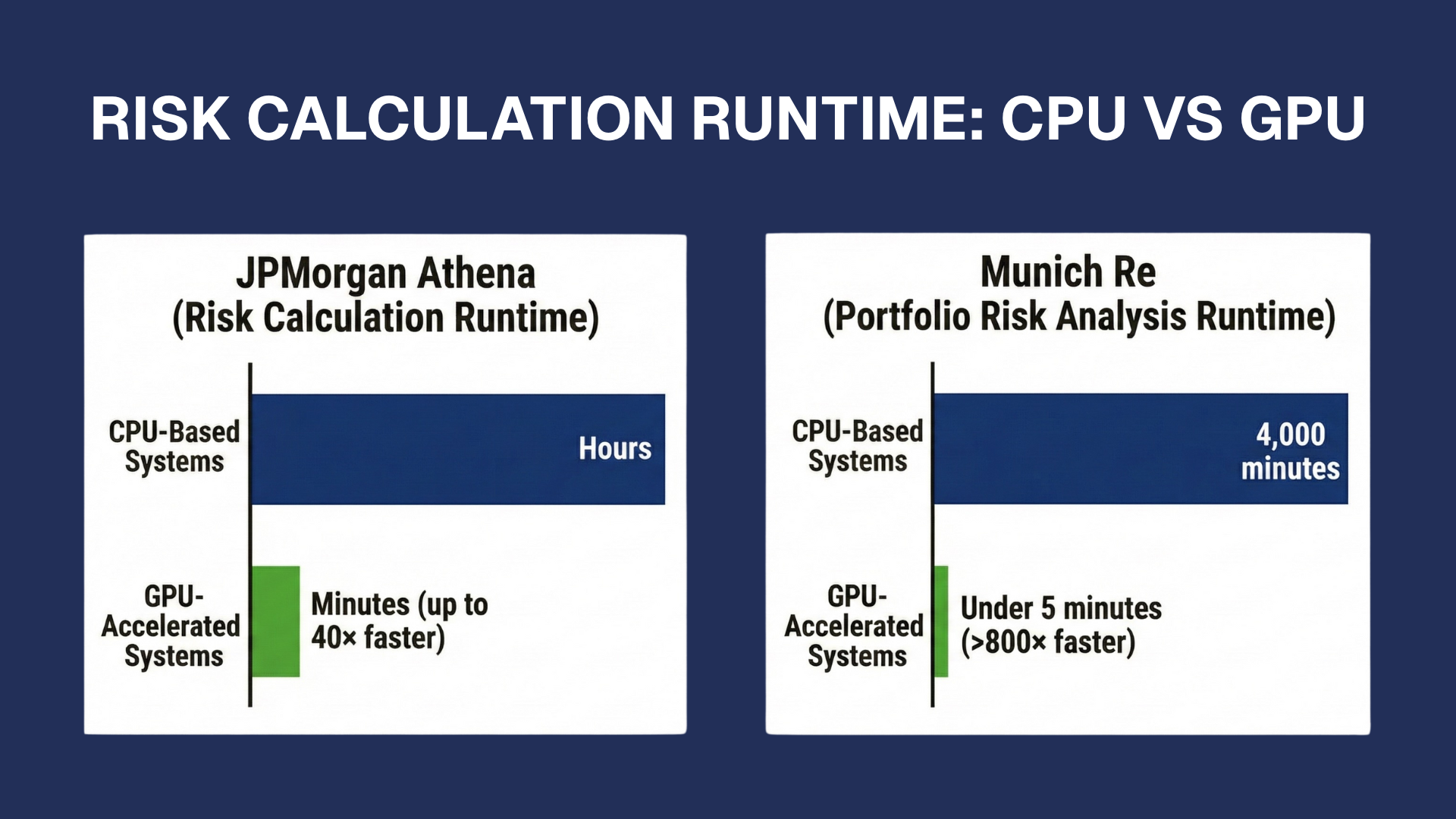
When JPMorgan modernized its Athena risk platform, it was because legacy, batch-based risk infrastructure was becoming a limiting factor in real-time markets. As the scope and frequency of risk calculations increased, CPU-based systems could no longer support timely insight. By moving core risk workloads onto GPU-accelerated infrastructure, the firm achieved performance gains of up to 40x, with risk calculations running in minutes rather than hours.

JPMorgan’s experience reflects a broader shift across financial services. As markets move faster and regulations demand deeper, more frequent risk insight, institutions are moving toward intraday risk management, real-time VaR, and Expected Shortfall under FRTB. AI can make risk models more adaptive, but at intraday scale, infrastructure, not algorithms, becomes the primary constraint.

This article outlines how intraday risk systems are being built, why GPU infrastructure is now central to real-time risk analytics, and what regulated institutions must consider when moving these systems into production.

Why Finance Is Turning to AI for Risk Management

The adoption of AI in risk management is driven less by experimentation and more by structural pressure on existing architectures. Regulatory frameworks such as Basel III and FRTB require risk to be measured with greater granularity, stronger governance, and increased frequency.

The shift from Value at Risk to Expected Shortfall materially increases computational load, particularly when calculations must be refreshed intraday and at the trading-desk level. Producing these metrics continuously is no longer feasible using batch-based workflows.

AI risk modeling helps institutions manage this complexity through large-scale simulation, adaptive recalibration, and richer sensitivity analysis. In regulated environments, however, these techniques only become operational when paired with infrastructure capable of sustaining continuous computation while preserving transparency and control.

Core AI Techniques Supporting Intraday Risk

At intraday scale, familiar risk techniques place fundamentally different demands on infrastructure. Risk management does not rely on new modeling concepts, but the way established methods operate changes materially when calculations must run continuously, respond to live market movement, and remain explainable and auditable under regulatory scrutiny.

As recalculation frequency increases, stress testing and Monte Carlo simulation place sustained pressure on compute. Monte Carlo remains central to market and credit risk, but refreshing simulations intraday sharply raises computational demand. GPU acceleration enables large-scale parallel execution, making continuous recalculation operationally viable in production environments.

These infrastructure demands intensify further under intraday VaR and Expected Shortfall. FRTB-driven Expected Shortfall requires significantly more computation than traditional VaR, particularly when calculated at the trading-desk level and refreshed throughout the day. Delivering these metrics in real time depends on infrastructure that can sustain high-throughput simulation without introducing latency or sacrificing accuracy.

At the same time, continuous execution requires model monitoring and explainability to operate alongside core risk calculations. Techniques such as anomaly detection help surface unexpected changes in risk metrics, while methods such as SHAP support regulatory transparency. These governance workflows add nontrivial computational overhead that must run concurrently without degrading performance.

Together, these demands shift the core challenge of intraday risk management away from model design and toward reliable execution at scale. Compute performance, throughput, and determinism become central to whether AI-powered risk systems can function continuously in regulated production environments.

Why Intraday Risk Depends on Compute

Delivering intraday risk in production places fundamentally different demands on infrastructure than traditional batch-based systems. Real-time VaR and Expected Shortfall require continuous simulation, low-latency execution, and predictable performance under sustained load. As these calculations move from periodic reporting into live decision-making, infrastructure must support not only speed and scale, but also transparency, control, and reproducibility.

In regulated environments, these requirements surface most clearly around explainability at speed. Risk metrics must remain interpretable even as recalculation frequency increases. Techniques used to support explainability add nontrivial computational overhead, which infrastructure must absorb without delaying results or degrading performance.

Production risk systems must also enforce governance and data control. Risk workloads are subject to strict data residency, access control, and audit requirements, often limiting where and how computation can run. This pushes many institutions toward on-prem or hybrid deployments that provide tighter operational control while still supporting continuous recalculation.

Finally, intraday risk depends on latency predictability and audit replay. Institutions must be able to reproduce risk calculations exactly as they ran at a given point in time, including during periods of market stress. Predictable latency and deterministic execution are essential to ensure results can be audited, explained, and trusted by regulators and internal stakeholders alike.

Munich Re Markets: Portfolio Risk at GPU Speed

Munich Re Markets illustrates how GPU infrastructure enables explainable risk analysis at production speed. In a publicly documented workflow, the team evaluated portfolio risk across 100,000 simulated market scenarios and used interpretable machine learning to explain differences in allocation strategies. SHAP was required to meet governance standards and became the primary computational bottleneck.

On legacy CPU infrastructure, the analysis exceeded 4,000 minutes, limiting its usefulness to periodic research. After refactoring the pipeline to a GPU-native stack on an NVIDIA DGX Station with four V100 GPUs, runtime dropped to under five minutes, an improvement of more than 800x. This shift allowed the analysis to move into regular risk workflows while preserving regulatory-grade explainability.

‍Supporting Production-Grade Risk Systems with Arc Compute

As risk teams move toward continuous, intraday calculation, infrastructure becomes a control layer rather than a supporting service, which is the same inflection point that drove JPMorgan’s modernization of Athena.

Arc Compute provides GPU infrastructure for regulated financial workloads through on-prem and hybrid deployments. These environments deliver predictable performance, support data residency and auditability, and enable AI-powered risk systems to run reliably at scale. As intraday risk becomes the default operating model, infrastructure choices will increasingly determine which institutions can translate AI insight into real-time, trusted decision-making.

References

Scaling Fraud Detection in 2026: Why GPU Acceleration Is Non-Negotiable for Real-Time Anti-Money Laundering

Fraud detection has crossed a threshold. At global payment scale, financial institutions no longer have minutes to investigate risk. They have milliseconds.

Networks like Mastercard process approximately 165 million transactions per hour, while businesses surveyed by TransUnion report losing an average of 7.7% of annual revenue to fraud, equivalent to $534 billion across respondents. At this scale, fraud prevention is no longer a rules problem or even a model problem. It is an infrastructure problem.

The shift toward graph-based machine learning, real-time inference, and agentic AI workflows has fundamentally changed the compute profile of anti-money laundering (AML) systems. CPU-bound architectures increasingly struggle to meet latency, throughput, and explainability requirements at the same time.

This is why GPU acceleration is becoming non-negotiable for real-time AML and transaction monitoring. It is not an optimization. It is a prerequisite for operating modern fraud stacks at production scale.

The Limits of Rules-Based and CPU-Only Fraud Detection Systems

Traditional fraud detection systems rely heavily on rules engines and sequential processing. These approaches were designed for lower transaction volumes and simpler threat models. Transactions are evaluated largely in isolation, using static thresholds that cannot adapt quickly to new fraud patterns.

As transaction volumes increase and fraud becomes more coordinated, these systems generate excessive false positives while still missing organized fraud rings. Manual review teams become overloaded, operational costs rise, and risk exposure increases.

Machine learning improved detection accuracy but introduced a new constraint: compute latency at scale. As models grow more complex and context-rich, CPU-only infrastructure becomes a bottleneck, particularly when real-time decisioning is required.

From Machine Learning to Agentic AI in AML Platforms

Modern AML platforms are evolving toward agentic AI.

Agentic AI refers to supervised AI agents that orchestrate multi-step AML workflows, including data enrichment, graph traversal, risk scoring, alert prioritization, and case summarization. These systems operate with human-in-the-loop controls, auditability, and policy guardrails to meet regulatory expectations.

This shift dramatically improves investigation speed and consistency, but it also increases computational demand. Agentic workflows require low-latency inference across multiple models and tools, often running in parallel. CPU-based systems struggle to deliver this performance reliably at transaction scale.

Why Graph-Based Fraud Detection Changes the Compute Equation

Fraud does not occur in isolation. It propagates through networks of accounts, devices, merchants, and identities.

Graph analytics and graph neural networks (GNNs) have become central to modern fraud detection, enabling institutions to identify fraud rings, mule networks, and coordinated attacks that linear models cannot detect.

Graph workloads are inherently parallel and memory-intensive. Real-time graph traversal, embedding generation, and inference quickly overwhelm traditional CPU architectures. Once fraud detection becomes graph-native, GPU acceleration becomes essential to meet real-time latency requirements without sacrificing model depth or detection quality.

Real-Time Inference at Transaction Scale

Modern payment networks process tens of thousands of transaction messages per second, while internal systems evaluate far more events, features, and risk signals in parallel.

GPU-accelerated inference enables financial institutions to:

  • Score transactions in real time without reducing model complexity
  • Run ensemble models and graph ML pipelines concurrently
  • Reduce false positives while maintaining high detection accuracy

In production deployments, GPU acceleration has enabled:

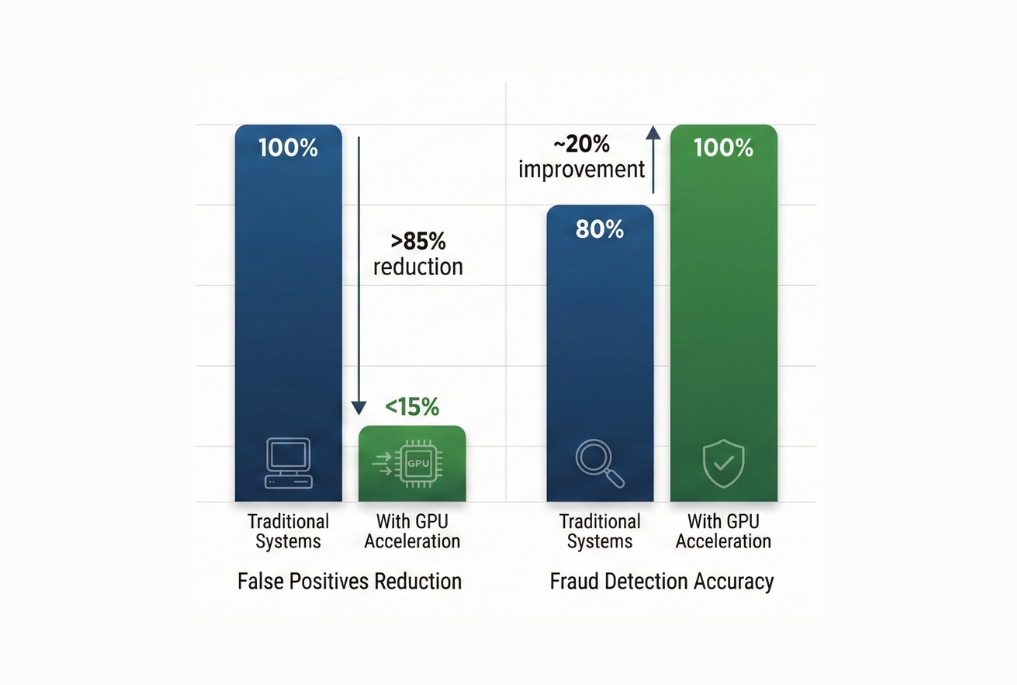
  • More than 85% reduction in false positives
  • Approximately 20% improvement in fraud detection accuracy
  • Approximately 165 million transactions processed per hour

‍AML Infrastructure as a Compliance Enabler

AML platforms are not evaluated solely on detection performance. They must also be explainable, auditable, and operationally reliable.

Regulators expect timely monitoring, defensible decisions, and complete audit trails. This pushes AML systems toward always-on inference and continuous monitoring, where latency and system stability directly affect compliance outcomes.

GPU-accelerated infrastructure allows institutions to maintain consistent low-latency performance, generate explanations without delays, and support investigator workflows at scale. In this context, GPUs are not just performance accelerators. They are compliance enablers.

Cloud vs Dedicated GPU Infrastructure for Real-Time AML

Public cloud infrastructure remains valuable for experimentation, model training, and burst capacity. However, always-on real-time AML introduces constraints around latency determinism, data residency, and cost predictability

As a result, many institutions deploy dedicated or single-tenant GPU infrastructure for core AML workloads, while continuing to use cloud resources for development and overflow. This hybrid approach balances flexibility with the performance and reliability required for production transaction monitoring.

The Future of AML Is Compute-Bound

Modern AML systems are being forced to make decisions with incomplete time and infinite context.

That tension is reshaping fraud detection from a modeling challenge into an infrastructure one.

The platforms that succeed will be those designed to sustain real-time graph analysis and continuous inference under production load, not just in controlled benchmarks. This is where infrastructure choices quietly determine outcomes long before alerts ever reach investigators.

At Arc Compute, we work with teams building GPU infrastructure for exactly these conditions, where latency, determinism, and scale are engineered upfront. As AML moves deeper into real-time operation, this foundation becomes less visible but far more decisive.

Ready to scale your fraud infrastructure? Contact our team today to discuss dedicated GPU solutions for Fintech and AML.

Sources

The $7 Trillion Reality Check: AI’s Battle Is Concrete, Not Code

AI’s biggest breakthrough won’t be determined by a larger context window or a smarter reasoning engine. It will be determined by who can keep the lights on.

The industry is obsessed with models, benchmarks, and architectures, but the real AI race has already moved elsewhere. It is no longer a software challenge. It is a battle against the physical world: power grids that can’t keep up, cooling systems hitting thermal walls, land shortages, and silicon supply chains pushed to their limits.

By 2030, global data centers will require an estimated $7 trillion in cumulative investment to maintain current trajectories. About $5.2 trillion of that is earmarked specifically for AI workloads.

Most companies still aren’t ready for what that means. Here is the reality of the next five years of AI infrastructure.

The Demand Curve Is Vertical

AI workloads are cannibalizing the data center. By 2030, roughly 70% of new capacity will be driven exclusively by AI. Two massive forces are compounding this growth:

1. The “Application Layer” Lag

The real value isn’t the model, it is the workflow. Companies are demanding private LLMs, agentic workflows, and inference at scale. If these use cases stall, demand softens. But if AI embeds into day-to-day operations, as early data suggests, demand will shatter current projections.

2. The Efficiency Paradox

DeepSeek V3 and similar architectures report training cost reductions of approximately 18× and inference reductions of approximately 36× compared to previous dense models.

That sounds like savings, but it isn’t.

Just as cheaper storage in the 2000s led to more data, cheaper compute leads to more experimentation. Teams don’t bank the savings. They run more variants and train larger datasets. Efficiency doesn’t lower the bill, it increases the output.

Follow the Money: Where the $5.2 Trillion Is Going

If we examine where that projected AI investment lands, the hierarchy is clear:

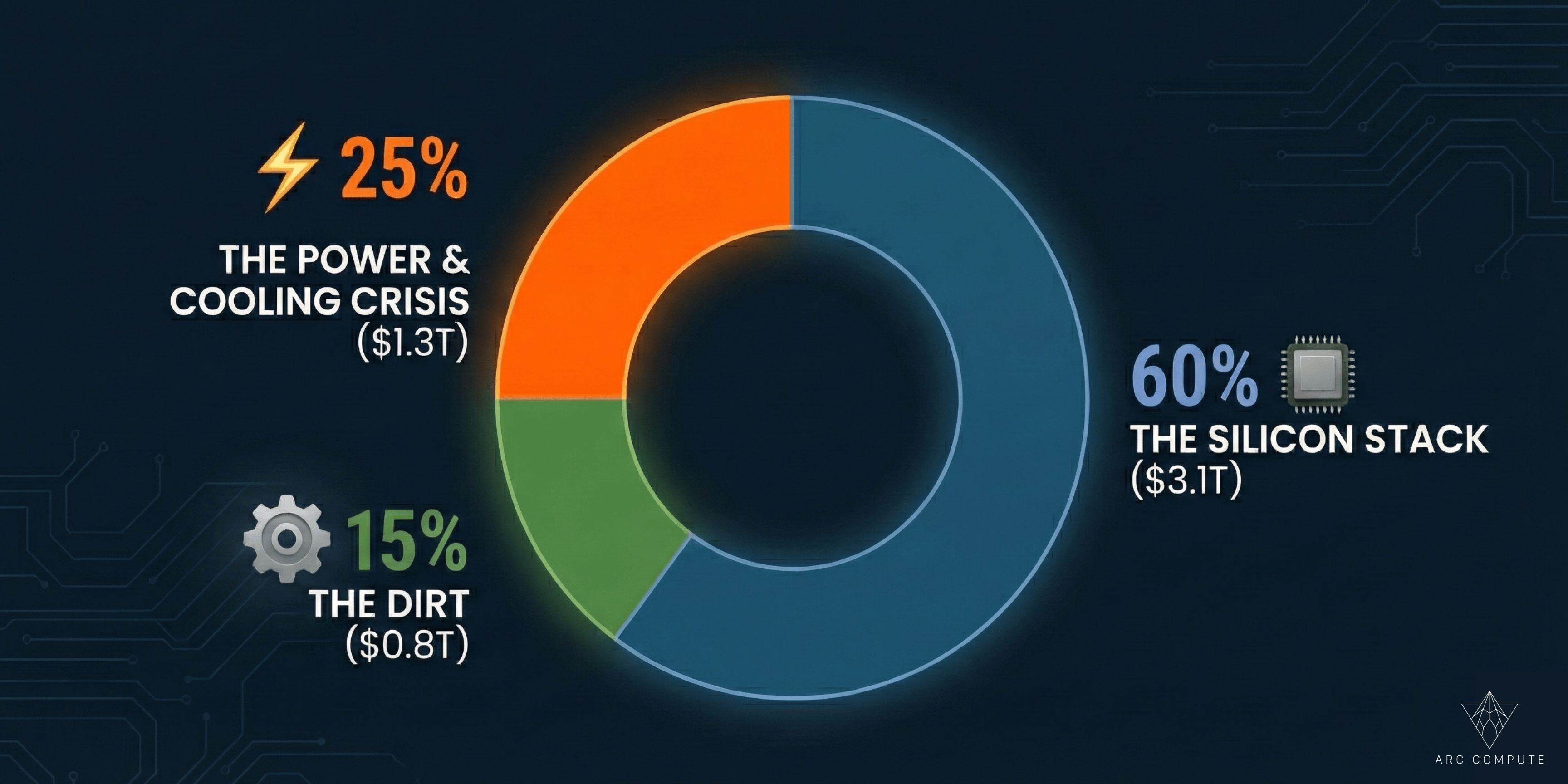
‍60% — The Silicon Stack ($3.1T)

GPUs, HBM memory, NICs, and rack hardware. Supply chain constraints here are structural; even if demand dips, prices remain sticky due to manufacturing complexity.

25% — The Power and Cooling Crisis ($1.3T)

This is the choke point. Racks are jumping from 5 kW to 100–250 kW monsters. Direct-to-chip liquid cooling is no longer exotic; it is mandatory.

15% — The Dirt ($0.8T)

Data centers need land with fiber access, cooling feasibility, and regulatory approval. Power-permitted land is now one of the world’s most valuable real estate classes.

The New Bottlenecks (It’s Not Just GPUs)

Everyone is trying to secure GPU clusters, but the limiting factor has shifted.

1. Power Is the New Gold

You can buy 8 racks of B300 nodes faster than you can secure 10 MW of stable power. In hubs like Northern Virginia and parts of Europe, interconnection queues stretch 3–6 years.

2. The Heat Wall

Air cooling is obsolete for cutting-edge systems. Blackwell and B-series GPUs push thermal densities that air simply can’t handle efficiently. If a facility isn’t plumbed for liquid cooling, it is effectively dead on arrival for next-generation training clusters.

3. The Geopolitical Tax

Tariffs and export controls have turned supply chains into minefields. Anything touching advanced chips or high-voltage power equipment is subject to regulatory volatility.

The Playbook for the Next Decade

The race is no longer about who has the smartest model. It is about who has the plugged-in compute. Every serious player, from hyperscalers to sovereign AI nations, is following the same rules:

Secure Power First

If you don’t have the megawatts, the silicon is a paperweight.

Build in Checkpoints

No one deploys $500 million blindly. Smart operators scale in phases (5 MW to 20 MW to 50 MW) to avoid stranded assets.

Prioritize Flexibility

The winning facilities are modular and vendor-agnostic. We do not know what model architectures will look like in 2027, so locking into a rigid facility design is a fatal error.

The Bottom Line

Compute demand is decoupling from efficiency gains. Even as models get leaner, usage is exploding. Inference is becoming the dominant cost. Power is becoming the dominant constraint. Liquid cooling is the new standard, but it will take 5–10 years before most data centers are ready.

If you’re building in the GPU infrastructure space, the era of cheap, available compute is over.

Conclusion: The Physics Will Decide the Winners

The limits of AI are no longer algorithmic. They are electrical, thermal, and physical.

Efficiency gains won’t soften demand; they will intensify it. The next generation of clusters will require infrastructure that legacy data centers simply weren’t built to support.

The AI race has shifted from intelligence to industrialization.

Companies that succeed will be the ones that understand power, heat, land, and silicon, and can build for a world where all four are scarce.

At Arc Compute, we built our company vision on this reality.

We are developing GPU infrastructure designed for the world as it is: power constrained, thermally demanding, and scaling faster than traditional facilities can keep up.

The world is still talking about code, but the winners of the next decade will be the ones who master the physics.

The Hidden Crisis in AI Right Now: Server Memory Is In Short Supply – Here’s How to Stay Ahead of It

AI teams are running into a problem the market isn’t built to solve: server memory prices are up more than 300 percent this year thanks to supply shortages and high demand for AI servers, yet DRAM suppliers are holding production flat and shifting capacity to higher-margin AI components. That imbalance has pushed server memory prices up 20 to 40 percent quarter-over-quarter, turning system RAM into the second most painful line item in every H100, H200, and Blackwell server.

In that chaos, many vendors are defaulting to oversized 3 TB configurations built on the most supply-constrained DIMMs, quietly adding tens of thousands of dollars per node. The catch is simple: most workloads will never use that capacity.

The shortage is real, but the cost trap is optional.

AI’s Next Bottleneck Isn’t Compute, It’s Memory

Every GPU server is built on two memory domains: high-bandwidth HBM memory attached to the GPU and system DRAM connected to the CPU. The HBM pipeline is tight, but it is predictable and largely shielded behind NVIDIA and AMD’s procurement scale.

System memory is where cracks are forming.

Server DRAM and enterprise SSDs are experiencing the sharpest supply constraints in years. Manufacturers are allocating output toward the AI sector but not expanding actual production capacity. As demand continues to surge, that decision creates a cascading effect across the entire ecosystem: higher prices, longer lead times, and lower availability of common configurations.

For enterprises building H100H200, or Blackwell clusters, this is no longer a procurement inconvenience. It is the constraint shaping architecture, timelines, and total cost of ownership.

What Modern GPU Servers Actually Need

Most high-performance AI servers follow one of two CPU architectures:

  • Intel-based systems with 32 DIMM slots 
  • AMD-based systems with 24 DIMM slots

Across real production deployments, roughly 80% of Arc Compute customers choose Intel-based systems, which means 32 DIMMs is the practical standard.

Before the shortage cycle, almost every enterprise deployment stabilized around:

  • 64 GB DIMMs 
  • ‍All slots populated 
  • ‍2.0 TB of system memory

For three to four years, across LLM training, fine-tuning, RAG pipelines, multi-modal applications, and computer vision workloads, 1.5 to 2.0 TB has consistently been the real-world requirement.

Then the supply chain shifted, and the ecosystem began pushing far larger footprints.

The 3 TB Trap: Overspec’ing in a Shortage Market

Many vendors have quietly normalized 3 TB system memory as the new standard for Blackwell-era servers. To hit that capacity, they rely on:

  • 96 GB DIMMs 
  • 128 GB DIMMs
  • Or even higher-capacity modules introduced specifically for AI demand

These DIMMs live in the most supply-constrained tier of the market. And that is exactly why vendors push them.

A single GPU server configured with 96 GB DIMMs can cost 30,000 to 40,000 dollars more than the same system built on 64 GB modules. In extreme cases, 128 or 256 GB DIMMs can push system cost up by 100,000 dollars or more per node.

This is one of the largest silent budget leaks inside modern AI infrastructure. And in 95 percent of real workloads, the extra memory sits idle.

Overspec’ing does not solve a technical problem. It amplifies a supply-chain one.

Why Most Workloads Don’t Need 3 TB or More

Host-side DRAM is used for:

  • Data ingestion
  • Preprocessing pipelines
  • Framework overhead (PyTorch, TensorFlow, JAX)
  • Caches, routing layers, and service meshes
  • Multi-tenant orchestration

None of the heavy tensor math lives here. Weights, activations, and model state live in one place: HBM on the GPU.

You genuinely need more than 2 TB only if you are:

  • Running extreme MoE architectures
  • Managing massive in-memory feature stores on each node
  • Packing multiple heterogeneous services into a single physical server by choice

If that is your situation, you already know. For everyone else, 2 TB is not a compromise. It is smart engineering.

Why the Shortage Persists

DRAM fabs could expand output, but they are not. Increasing production means billions in CapEx and years of lead time. Instead, top suppliers have stated publicly that they are investing in higher-margin AI memory products rather than expanding general DRAM capacity.

Meanwhile:

  • AI GPU shipments continue to climb
  • Hyperscalers absorb the majority of available inventory
  • Enterprise buyers compete in a constrained procurement lane

‍This is why system memory volatility is now tightly linked to AI expansion. The supply chain was not built for this growth curve, and it will not stabilize overnight.

How to Stay Ahead of the Memory Crisis

1. Specify DIMM size in writing

Never leave memory configuration to vendor defaults. Require 64 GB DIMMs unless your workload demands otherwise.

2. Standardize on 2 TB for H100, H200, B200, and B300

Treat this as the baseline for 8-GPU servers. If your host-side memory pressure is low today, it will stay low unless your architecture changes materially.

3. Request itemized memory tier pricing

Make vendors show the cost impact of 2 TB vs. 3 TB vs. 4 TB. Transparency shifts leverage to your side.

4. Benchmark with your real workloads

Validate performance on 2 TB. If there is no measurable gain at 3 TB, do not buy it.

5. Capitalize on lower lead times

Right-sized configurations do not just cost less. They ship faster, because they avoid the constrained DIMM tiers. This is how you protect your budget and accelerate your deployment schedule in a supply chain that rewards discipline.

Arc Compute’s Perspective

We sit at the intersection of AI demand and hardware supply every day. We have watched pricing swing by tens of thousands of dollars per server due purely to system memory choices. We have seen organizations inadvertently inflate cluster cost by seven figures because a vendor positioned 3 TB as future-proofing.

Our recommendation is consistent:

  • 2 TB is the strategic default 
  • 64 GB DIMMs are the optimal building block 
  • 3 TB or more should be reserved for workloads that can empirically justify it 
  • Overspec’ing system memory during a global shortage is the fastest way to waste budget

AI infrastructure is expensive enough. Memory inflation does not need to make it worse.

If your next GPU deployment includes H100, H200, or Blackwell systems, contact us and we can help you validate the right configuration, avoid overspec’ing traps, and stabilize your cost curve before hardware scarcity does it for you.

Becoming AI Native in High Frequency Trading: Why GPUs Are Now Essential

Even two or three decades ago, high frequency trading was already one of the most technologically advanced and competitive frontiers in finance. Today, it has only become more competitive as AI native strategies grow more widespread and accessible. With tools that lower the barrier to entry and a market that evolves in microseconds, firms must now excel in two disciplines at once: absolute speed and advanced intelligence. To compete effectively, trading organizations must design infrastructure that delivers both, and GPUs have become central to making that possible.

How High Frequency Trading Works Today

HFT is often described as fast trading, but speed is only one piece. Modern strategies combine three capabilities:

  1. Ultra low latency, reacting to market data in microseconds
  2. Massive parallel analysis, processing thousands of signals simultaneously
  3. Real time model adaptation, adjusting strategies dynamically as liquidity regimes change

Firms ingest tick level data from many venues, simulate short term price dislocations, evaluate micro patterns within the order book, and route orders through optimized execution paths.

This requires computing infrastructure that can:

  • Run thousands of Monte Carlo paths in parallel
  • Recalculate fair value models instantly
  • Analyze full order book depth without bottlenecks
  • Update model parameters intraday
  • Execute inference with minimal jitter

For years, this workload relied heavily on overclocked CPUs and FPGAs. CPUs offered flexibility. FPGAs offered deterministic latency.

But today’s trading is not only about reacting faster. It is about thinking faster. This shift has pushed GPUs to the forefront.

Why GPUs are Now Essential in HFT

GPUs were once seen as suitable only for overnight risk calculations, too slow for live trading. That is no longer true.

Modern GPU architectures, improvements in CUDA software, and networking technologies now allow GPUs to operate within the ultra low latency envelope required for production trading systems, while providing thousands of cores for massive parallel computation.

1. Parallelism for Strategy Development

Back testing, reinforcement learning experiments, and market simulation all benefit from GPUs and their ability to run thousands of simulations at once.

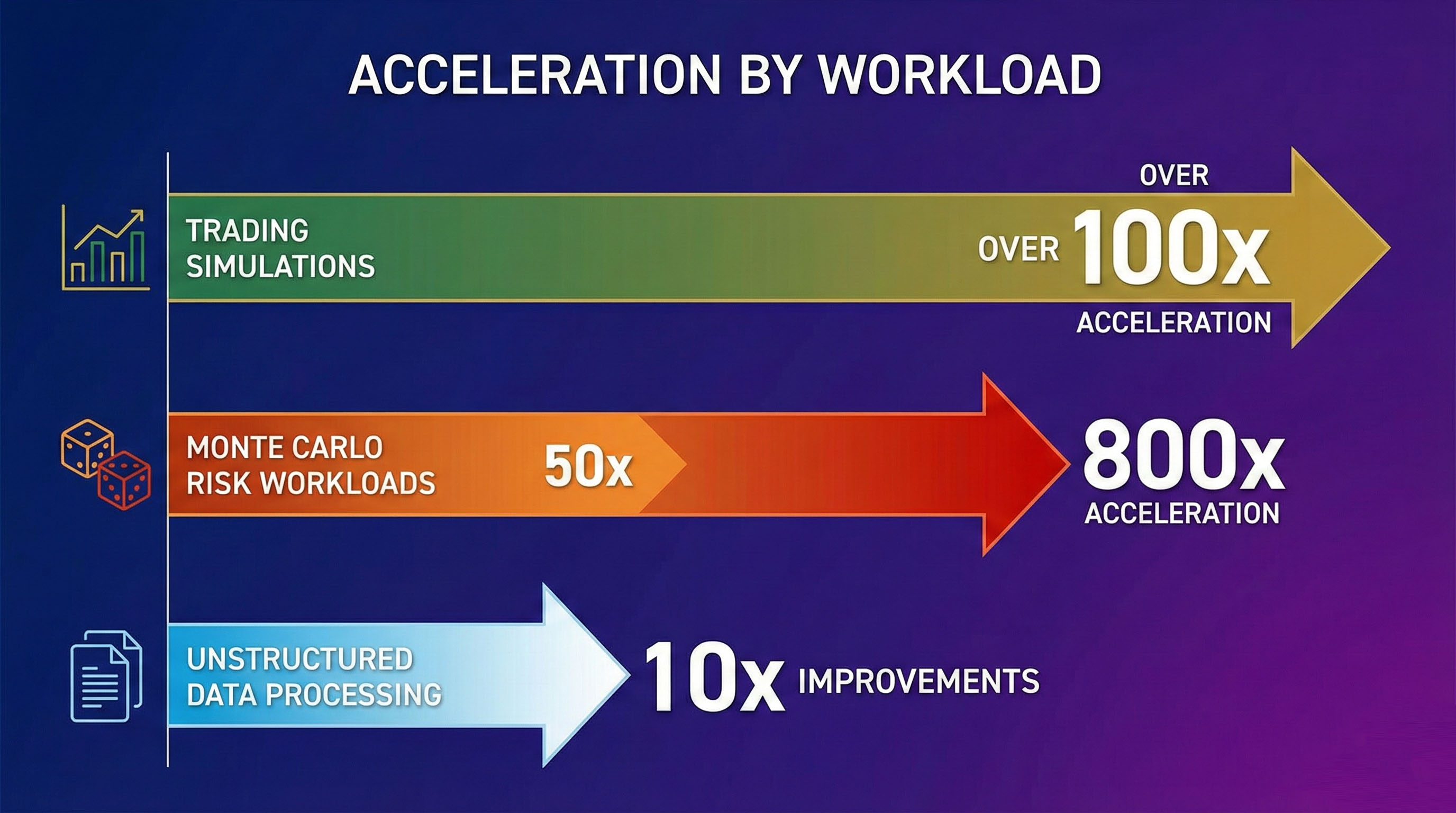
Benchmarks show:

  • Over 100 times acceleration for trading simulations
  • 50 to 800 times acceleration for Monte Carlo risk workloads
  • 10 times improvements in unstructured data processing

This speed does more than make analysis faster. It changes the scale of what is possible. Firms can simulate years of intraday data in hours, train reinforcement learning modules on many synthetic market scenarios, and explore model variants that would be impractical on CPUs.

2. Low Latency Inference for Live Markets

Modern HFT increasingly relies on machine learning inference, including short term direction prediction, liquidity shifts, and volatility forecasts.

GPUs now deliver inference latencies in the double digit microseconds, fast enough for many latency sensitive strategies. Techniques such as persistent CUDA kernels, CUDA Graphs, and GPUDirect RDMA have eliminated much of the overhead that previously made GPUs unsuitable for live execution.

3. Speed and Intelligence Now Matter More Than Ever

Networking has pushed physical latency closer to theoretical limits, and shaving off microseconds remains just as critical today as it has always been. At the same time, modern trading requires extracting far more intelligence from the same tiny time window. Firms must excel at both. AI driven research workflows, richer feature extraction, larger context windows, and dynamic decision logic all benefit from the parallelism GPUs provide. While the most latency critical paths still rely on deterministic execution, many firms now combine fast models with fast execution, integrating adaptive AI techniques in the research and development cycle and in certain execution layers outside the nanosecond loop. As more AI native tools lower the barrier to entry for new participants, competitive firms must optimize both raw speed and advanced intelligence to stay ahead

What Leading Trading Firms Are Doing

Across the industry, one theme is clear. Top tier trading firms are now deeply GPU centric.

  • Large market making firms use GPU accelerated infrastructure for large scale simulation, reinforcement learning, and quantitative research.
  • Banks with advanced AI research labs train transformer models and reinforcement learning execution engines on multi GPU clusters, reducing research cycles from many months to a few weeks.
  • Proprietary trading firms deploy GPU servers in colocation centers for real time analytics and low latency inference.

Even smaller quant shops use hybrid architectures. FPGAs handle the critical nanosecond loop. GPUs handle signal generation, simulation, research workloads, and real time risk. The result is a new market reality. Competitive edge now depends on who understands the data fastest, not only on who receives it first.

The Infrastructure Challenge: Cloud vs. Bare Metal

Public cloud is appropriate for experimentation and elastic research workloads. It breaks down in production trading.

HFT workloads suffer from:

  • Jitter caused by noisy neighbors
  • Virtualization overhead
  • Unpredictable cross region latency
  • High costs for continuous GPU use

As soon as real time inference or continuous simulation enters the workflow, the cloud becomes both economically and technically limiting. For this reason, the industry is returning to dedicated, bare metal GPU infrastructure that provides deterministic performance.

Case in Point: Lynx Trading Technologies

Lynx, a proprietary trading firm, migrated from the public cloud to Arc Compute’s on premise NVIDIA HGX B200 systems. Within four weeks, they:

  • Eliminated cloud induced jitter
  • Gained full transparency and control over tuning
  • Reduced long term compute costs
  • Improved real time analytics performance

This shift allowed their quantitative team to run larger models, faster back tests, and more stable real time signals. They achieved this without unpredictable performance variation or growing cloud bills.

Their experience reflects a broader industry trend. Firms that need real time intelligence must own the metal. Read the full case study here.

How Arc Compute Powers the Next Generation of Trading

Modern HFT requires infrastructure that delivers deterministic latency together with high intelligence throughput. Arc Compute specializes in delivering purpose built GPU infrastructure for trading, quantitative research, and risk analytics.

Our systems are optimized for:

  • Real time model inference
  • Parallel strategy simulation
  • Deep learning pipelines
  • Hybrid reinforcement learning workflows
  • Monte Carlo analytics
  • Data intensive quantitative research

Our server portfolio includes the latest NVIDIA HGX platforms (i.e HGX B300s) with high bandwidth HBM3e memory, advanced NVLink interconnects, and high-speed networking options. These are designed specifically for firms that cannot tolerate jitter, downtime, or capacity ceilings. We can also build the right AI architecture with other new technologies like the RTX Pro 6000s and more.

Whether deployed on premises, in colocation, or as part of a hybrid model, Arc provides:

  • Predictable performance
  • Dedicated, single tenant environments
  • Infrastructure tuned for financial microstructure
  • End to end consultation from sizing to deployment

In today’s markets, compute power is competitive advantage. Firms that modernize their infrastructure now, and treat GPU acceleration as foundational rather than optional, will define the next decade of trading.

Aivres NVIDIA HGX B200 & B300 GPU Servers: Air and Liquid-Cooled Performance at Scale

Today’s AI-driven enterprises and research institutions require more than raw performance. They need scalable, reliable infrastructure that can be deployed fast and operated efficiently. That’s where Aivres comes in. As a trusted OEM, Aivres builds high-performance GPU infrastructure optimized for large-scale AI and HPC workloads, with agile manufacturing and enterprise-grade support.

Available through Arc Compute, Aivres NVIDIA HGX B200 and B300 GPU Servers offer both air and liquid-cooled options, supporting some of the most demanding use cases in AI, LLM training, scientific research, and enterprise computing.

Server Overview: KR9288 and KR5288 Platforms

The Aivres KR9288 and KR5288 platforms support both NVIDIA B200 and B300 SXM GPUs with Intel or AMD CPUs. These systems are engineered for high throughput, GPU utilization, and data center compatibility across retrofit and next-gen liquid-cooled environments.

KR9288 (Air-Cooled)

Model
CPU Option
GPUs
Cooling
Standard Memory
Networking
Storage
KR9288-X3
Intel Xeon 6
8x B200
Air
2 TB DDR5
8x ConnectX-7 400G
8x NVMe U.2 + 2x M.2
KR9288-E3
AMD EPYC 9005
8x B200
Air
2 TB DDR5
8x ConnectX-7 400G
8x NVMe U.2 + 2x M.2
KR9288-X3
Intel Xeon 6
8x B300
Air
2 TB DDR5
8x ConnectX-8 SuperNIC
8x NVMe U.2 + 2x M.2
KR9288-E3
AMD EPYC 9005
8x B300
Air
2 TB DDR5
8x ConnectX-8 SuperNIC
8x NVMe U.2 + 2x M.2

KR5288 (Liquid-Cooled)

Model
CPU Option
GPUs
Cooling
Standard Memory
Networking
Storage
KR5288-E3
AMD EPYC 9005
8x B200
Liquid
2 TB DDR5
8x ConnectX-7 400G
8x NVMe U.2 + 2x M.2
KR5288-X3
Intel Xeon 6
8x B300
Liquid
2 TB DDR5
8x ConnectX-8 SuperNIC
8x NVMe U.2 + 2x M.2
KR5288-E3
AMD EPYC 9005
8x B300
Liquid
2 TB DDR5
8x ConnectX-8 SuperNIC
8x NVMe U.2 + 2x M.2

For full technical specs, refer to the KR9288 product page and KR5288 liquid-cooled series

Cooling Options: Air vs. Liquid

The arrival of B200 and B300 GPUs with TDPs reaching up to 1000W requires a forward-looking thermal strategy. Aivres supports both approaches:

  • Air-Cooled Systems: The KR9288 chassis is designed exclusively for air cooling, making it ideal for retrofit data center environments. It features 20 hot-swappable 80×86mm fans for high airflow.
  • Liquid-Cooled Systems: The KR5288 platform enables next-generation liquid cooling for enhanced thermal performance and long-term energy efficiency.

Read more on sustainable GPU data center design

Use Cases for B200 and B300 Systems

These systems are designed to meet the scale and complexity of modern AI and HPC workloads:

  • LLM Training: Train massive transformer models across 8x B200 or B300 GPUs using NVLink and NVSwitch interconnects
  • Inference at Scale: Deploy high-throughput, memory-intensive inference pipelines with fast inter-GPU communication
  • HPC Applications: Run advanced simulations in climate, physics, engineering, and genomics
  • Enterprise AI: Power distributed platforms with hybrid or multi-tenant workloads requiring predictable performance

Which Aivres Server Is Right for You?

Choosing between B200 and B300 systems comes down to performance needs, deployment timeline, and budget:

  • Choose the Aivres HGX B200 if you’re building a high-performance cluster for LLMs, inference, or HPC and want a reliable, cost-effective platform that balances compute with power efficiency. It’s ideal for organizations that want top-tier performance without the bleeding-edge pricing of B300.
  • Choose the Aivres HGX B300 if you’re pushing the limits of model size, batch throughput, or working with real-time AI at scale. With more memory per GPU, higher FP4/FP8 throughput, and integrated ConnectX-8 SuperNICs, B300 systems are built for frontier AI workloads.

For pricing guidance:

  • The Aivres HGX B200 has a starting price of ~$340k USD depending on final configuration.
  • The Aivres HGX B300 has a starting price of ~$430k USD.

Arc Compute offers volume discounts for larger orders and educational discounts for qualified institutions. While our site features the most common air-cooled configurations, liquid-cooled variants of both B200 and B300 servers are also available. These typically carry a modest price increase due to their advanced thermal design, and are well-suited for high-density deployments.

Explore our product pages for more:

Why Choose Aivres

Choosing the right OEM is just as important as selecting the right GPU. Aivres delivers:

  • Speed: Proven deployment velocity for AI labs and enterprise teams
  • Flexibility: Broad CPU support and customizable storage and networking options
  • Reliability: Enterprise-grade hardware and support, including optional next-business-day on-site service

With systems built for both air and liquid cooling, Aivres enables fast deployment, long-term efficiency, and optimal uptime.

Build with Confidence

Whether you’re building a next-gen LLM training cluster or deploying a cost-efficient inference platform, Aivres B200 and B300 servers offer the performance, density, and adaptability to meet your AI infrastructure goals. Arc Compute helps organizations design and deploy these systems as part of complete GPU infrastructure stacks that integrate hardware, thermals, and orchestration.

Talk to our team to explore the right model for your next build.


Liquid Cooling & Green AI Infrastructure: Designing Sustainable GPU Data Centers

Liquid cooling is becoming the baseline for AI-ready infrastructure.

As AI, cloud, and HPC workloads scale, the limits of traditional air cooling are clear. Most data centers were designed for 5–20 kW per rack. But today, hyperscale environments are targeting 40–250 kW per rack, driven by the rapid growth of AI, Machine Learning, and HPC.

The global liquid-cooling market reflects this urgency: projected to surge from $2.8 billion in 2025 to over $21 billion by 2032, with CAGR exceeding 30%. The industry is moving fast because it has to.

Why Air is Falling Behind

Air cooling depends on high volumes of conditioned air, fan power, and aisle containment. Liquids move heat far more effectively. By volume, water carries roughly three thousand times more heat than air for a similar temperature rise, thanks to higher density and specific heat, along with better thermal conductivity. That physics advantage is why operators see lower cooling energy and easier heat transport with liquid.

The economics are compelling. Most systems achieve ROI in just two to four years thanks to lower cooling costs and space optimization. That’s why hyperscalers like Google, Microsoft, and Amazon are already re-architecting their facilities with liquid-ready infrastructure. The gap is widening between leaders who invest now and laggards who delay.

At the same time, AI data center power consumption and energy demand are rising sharply, drawing attention to the sustainability and cost implications of sticking with air.

Cooling Technologies: Direct-to-Chip vs Immersion

Two approaches are dominating deployments:

  • Direct-to-chip cooling delivers liquid coolant straight to CPUs and GPUs via cold plates. It’s modular, upgrade-friendly, and supports rack densities of up to 250 kW in many modern designs, while removing heat up to 1,000 times more efficiently than air.
  • Immersion cooling submerges servers in dielectric fluid, achieving >100 kW per rack and, in some designs, also scaling up to 250 kW. It eliminates fans entirely but typically requires more maintenance and operational oversight compared to direct-to-chip systems.

Both approaches extend hardware life, reduce mechanical complexity, and cut operating costs. The choice depends on your density targets, facility design, and ESG roadmap.

Cooling Approaches Compared

Cooling Method
Rack Density Support
Efficiency Gains
Deployment Complexity
Best Fit For
Air Cooling
~5–20 kW per rack
Baseline (PUE ≈1.4–1.6)
Low, standard
CRAC/CRAH
Legacy workloads, low-density enterprise
Direct-to-Chip
40–100 kW per rack
10–15% energy savings
Moderate, liquid-ready
servers & plumbing
Enterprises modernizing GPU servers
Immersion
100–250+ kW per rack
20%+ energy savings
Higher, tank deployment
& facility redesign
Hyperscalers, AI/HPC with ultra-dense racks

Sustainability and ESG Pressures

The debate around AI data centers and their environmental impact is intensifying. Communities are raising concerns about water usage, pollution, and carbon footprint. Searches for “how much water do AI data centers use” highlight the growing attention on water-intensive cooling methods. Regulators are tightening ESG mandates, and investors are scrutinizing AI data center sustainability when evaluating infrastructure projects.

Closed-loop liquid cooling systems are emerging as the preferred choice. They drastically reduce or eliminate water consumption by recycling coolant within a sealed circuit, mitigating both environmental and regulatory risk. These designs align sustainability goals with operational performance – avoiding the high water draw and waste associated with open-loop or evaporative systems.

Liquid cooling is one of the most effective responses. By slashing energy use, enabling water recycling, and optimizing space, it aligns performance with sustainability. It transforms environmental compliance from a cost burden into a competitive advantage.

Why Timing Matters

Adoption is already underway, but not evenly distributed. Hyperscalers are leading the way. Many enterprises and colocation facilities are still air-cooled, hoping to squeeze one more refresh cycle out of legacy infrastructure. But the physics won’t bend, and neither will ESG timelines.

As AI data center construction accelerates, the next wave of GPUs will require liquid-ready deployments. Those who prepare today will unlock higher capacity, lower costs, and stronger positioning in the green infrastructure narrative. Those who don’t will face efficiency bottlenecks and reputational drag.

Arc Compute’s Role

At Arc Compute, we help AI and HPC teams design GPU infrastructure that strikes a balance between performance and sustainability. That means modular, liquid-cooled GPU clusters built around NVIDIA H200B200, and B300 platforms, engineered for density and efficiency.

Liquid cooling isn’t just better for the environment. It’s becoming the industry standard for serious compute. Talk to us today about how Arc Compute can help you design liquid-ready infrastructure that scales with your AI ambitions and meets tomorrow’s ESG expectations.


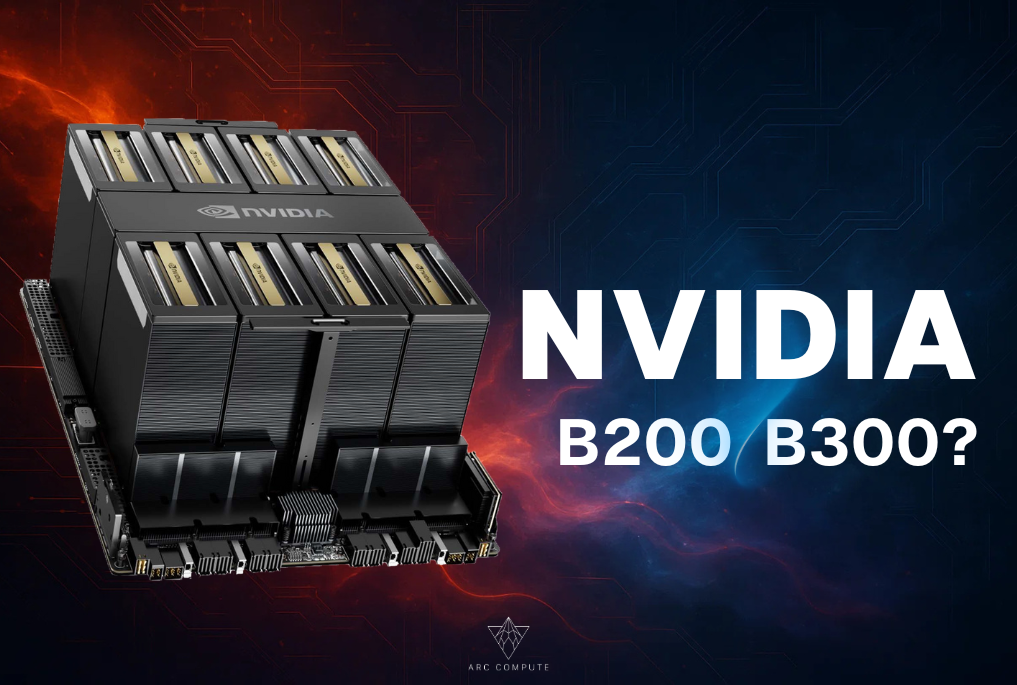
The Difference Between NVIDIA HGX B200 vs B300 vs GB300 NVL72

AI infrastructure decisions are defined by scale, efficiency, and readiness for next-generation workloads. As enterprises deploy large language models (LLMs), retrieval-augmented generation (RAG), and reasoning pipelines, the real constraints are not just raw compute. They are GPU memory ceilings, networking bandwidth, and data center power density.

For CTOs, ML engineers, and infrastructure leaders, the choice between NVIDIA HGX B200HGX B300, and GB300 NVL72 goes beyond comparing SKUs. It is about selecting a platform that supports trillion-parameter training, inference at scale, and AI factory-level throughput without stalling on facility constraints or operational costs.

Let’s break down the key differences between these platforms to help you make the best choice for your AI infrastructure.

What is the Difference Between NVIDIA HGX B200, HGX B300, and GB300 NVL72?

The biggest difference is in scale and integration. The HGX B200 is an 8-GPU platform built for balanced enterprise AI workloads, giving organizations a cost-efficient starting point. The HGX B300 also uses 8 GPUs but with the Ultra variant, delivering higher memory and bandwidth for advanced AI models that outgrow the B200. The GB300 NVL72 goes far beyond both, combining 72 Ultra GPUs with 36 Grace CPUs into a rack-scale system designed for multi-trillion parameter workloads and AI factory deployments.

Why Choose HGX B200?

Balanced Performance for Enterprise AI

The HGX B200 is the practical, cost-efficient choice for most enterprises. With 1.44 TB of HBM3e memory across 8-GPUs and robust NVLink/NVSwitch interconnects, it delivers high performance for AI training and inference without overwhelming data center resources.

  • Lower cooling and power complexity than rack-scale systems
  • Well suited to LLM training, fine-tuning, and inference workloads
  • Ideal for enterprises standardizing their first large-scale AI deployments

Why Choose HGX B300?

High-Memory Platform for Advanced Workloads

The HGX B300 introduces a step up in both memory and bandwidth. With ~2.3 TB of HBM3e across 8x Blackwell Ultra GPUs, it supports workloads that push beyond the limits of the B200.

  • Enables long-context LLMs, trillion-parameter training, and high-bandwidth inference
  • Acts as a bridge between balanced enterprise deployments and rack-scale platforms

Why Choose GB300 NVL72?

Rack-Scale Infrastructure for AI Factories

The GB300 NVL72 is the flagship rack-scale platform. With 72 GPUs, 36 Grace CPUs, and up to 21 TB of HBM3e, it is engineered for AI factories and reasoning workloads at scale.

  • Unlocks multi-trillion-parameter models and massive inference throughput
  • Designed for reasoning and test-time scaling at exascale
  • Requires facility-level upgrades such as liquid cooling, high-voltage distribution, and rack engineering

At-a-Glance: HGX B200 vs B300 vs GB300 NVL72

The Difference Between NVIDIA HGX B200, HGX B300, and GB300 NVL72

Key Questions AI Leaders Ask Before Choosing a GPU Platform

  • Can my facility handle it? NVL72 racks consume up to 132 kW and require liquid cooling plus advanced power distribution.
  • Is more memory always better? For workloads under 2 TB, B200 nodes are sufficient. B300 and NVL72 become necessary when model sizes and context windows exceed that ceiling.
  • Will interconnect bottlenecks hold me back? Strong NVLink interconnects are essential. NVL72’s rack-scale NVLink fabric eliminates common scaling inefficiencies.
  • How do I measure real performance? Move beyond peak FLOPS. Benchmark tokens per second per watt with your actual workloads.

Decision Framework: Matching GPU Choice to Your AI Roadmap

  • Choose HGX B200 if you need a balanced, cost-effective 8-GPU node with 1.44 TB of memory and manageable cooling and power.
  • Choose HGX B300 if you require ~2.3 TB of memory and higher interconnect bandwidth for advanced training and inference.
  • Choose GB300 NVL72 if you are building an AI factory with 72 GPUs and 36 CPUs, 21 TB memory, ~132 kW rack infrastructure, and need to handle multi-trillion parameter workloads at scale.

If you are still weighing the timing of your investment, our earlier guide on whether to wait for the B300 or deploy H200/B200 offers additional context.

Arc Compute Can Help

At Arc Compute, we help teams navigate GPU infrastructure decisions with clarity and precision. Whether you are deploying HGX B200, preparing for B300, or designing for GB300 NVL72, our experts ensure your infrastructure is aligned with both workload performance and long-term AI strategy.

Talk to an expert today to explore the best fit for your AI roadmap.